

Immersive storytelling for research

Author: Chris O’Brien
Published on: 30 November 2023
Exciting news in the world of creative storytelling landed this month with the launch of a UKRI infrastructure programme to fund world-class research and development in screen and performance technology. A key focus will be the development of extended reality (XR) experiences using virtual reality (VR), augmented reality (AR) and mixed reality (MR).
At the heart of the £75.6m CoSTAR national network is the CoSTAR National Lab for R&D in Creative Technology, led by Royal Holloway, University of London. It aims to ‘place R&D at the heart of UK storytelling and storytelling at the heart of the R&D’ and to ‘make Metaverse and AI technologies more inclusive, sustainable and democratic’.
The Lab builds on Royal Holloway’s StoryFutures, an impressive initiative that I’ve been following for a while. The programme has developed prototypes of narrative VR experiences and new storytelling approaches. Some are free to view on Meta Quest 2 headsets. They include The Museum of Imagined Futures, an immersive journey into what our oceans, forests and cities could look like in 50 years, and Accessible Lives, a look at 100 years of assistive technologies and the stories of people using them.
I first came across StoryFutures via an inspirational six-week Future Learn course called How to Make and Sell Your First Immersive Experience, co-developed by Royal Holloway and the National Film and Television School. The course introduced a variety of immersive storytelling techniques, including augmented reality and 360° filmmaking. It gave me the excuse to buy a VR headset – for research purposes you understand, although admittedly for a while afterwards, my party trick for house guests was to make them walk off a plank jutting out from the top floor of a skyscraper (hat tip to Richie’s Plank Experience).
The headset allowed me to watch the immersive films recommended in the Future Learn course. Mini-documentary Clouds Over Sidra, commissioned by the United Nations, took me to a Jordanian desert to learn about the life of a 12-year-old Syrian refugee. In short, it blew my mind. Firstly, because it was possible to make something so powerful a full nine years ago. See the YouTube video below – it’s not quite the headset experience but you can still watch in 360° by clicking on the image and spinning it around (note: this is best viewed on a laptop or android phone). Take a look, in particular, at the bakery scene at 2m14s. Secondly, as evidence of VR’s potential to be the ‘ultimate empathy machine’. UNICEF found that one in six people pledged donations after watching this film, twice the normal rate.
Mini VR documentary Clouds Over Sidra. Creators: Gabo Arora + Chris Milk. Commissioned by the UN.
It got my mind racing about the future role of XR technologies in communicating academic research, deepening audience engagement and translating research into impact. This could range from something as simple as a 360° clip of a researcher articulating their research vision in a highly visual lab environment, to more ambitious immersive experiences that visualise health or social policy datasets, or explain complex theoretical physics concepts like string theory.
Universities are at the forefront of so many good things happening in this space. As an example, the £15m XR Stories initiative, led by the University of York, is providing R&D funding, support and networking to develop new immersive and interactive digital storytelling techniques. Can’t wait to see how their Stories from the Ground project turns out – an AR-powered exploration of the hidden histories of food to encourage people to think more deeply about the global food chain.
So, this is a call for collaboration. We’d love to hear from any academic institutions or research groups interested in exploring how to increase engagement in research through immersive storytelling. Equally, we’re keen to chat with creatives who might be interested in participating in funding proposals to develop immersive experiences based around academic research. You can get in touch with us here.
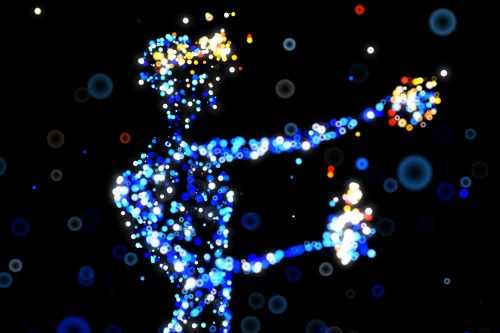
(Credit for main photo: Julien Tromeur on Unsplash).
